If I Were a Film Critic...
by Bernardo Bertolucci
If I were a film critic, I’d follow Jean Renoir’s suggestion when he said: ‘Don’t waste your time finding faults in the movies you detest, talk about the movies you love, and share your pleasure with others’. It is particularly useful to remember these words today, as there don’t seem to be many Renoirian critics around, especially in France. Concerning the querelle between French filmmakers and critics, I would like to say that a critic should, first of all, orient his readers by conveying the strongest feelings the movie stirs up in him. Sometimes, however, it is more honest for him to disorient the readers, if this is what the movie itself suggests. Is it possible to balance one’s own emotions by attempting to sound objective (‘che ci sia ciascun lo dice, dove sia nessuno lo sa’)? How can a critic control the alchemical process that triggers inside him when he starts writing about a film? Unlike literary critics, who are writers themselves and know about the splendor and misery of words, film critics almost always run into difficulty when interpreting cinematic writing – a movie’s language, its style. As a consequence, a kind of embarrassing distance develops between the critics and the text. Even the most gifted ones, when judging a movie, go about it by sections: its history, dramaturgy, acting, photography, scenes, costumes…
It’s very rare that a critic unveils what is hidden in the language of one of my films. I must admit that, when it does happen, it not only helps me understand myself more but also moves me deeply. It’s a great feeling when you sense that your movie stimulated, provoked, and sparked ideas in a critic – creativity shifted from the author to the reviewer. Both are enriched. Yet it doesn’t happen very often. I’m afraid that there are not many people who can competently interpret the complexity of cinematic writing, and most of these are filmmakers, directors of cinematography, grips, gaffers, in other words those who habitually work behind or around the camera, even down to the makeup artist assistant. This is a fact.
It’s also good to remind ourselves that critics’ judgments play no part in the life and success of blockbuster movies, which these days proceed with the power of siege engines, supported by enormous promotional media investments. For more ambitious films instead, that is, films that attempt to speak to a select public, generally negative reviews can be catastrophic. Between the lines of the reviews in the three or four Parisian publications in question, one sometimes catches thuggish and disparaging undertones that suggest: ‘Let’s kill it while it’s young’, and other pleasant innuendos. In such cases, the fate of the movie is sealed. In addition, the hyperbole of judgment is generally not supported by equally ‘brilliant’ critical arguments, and often the ‘killer phrase’ is followed by reductive, simplifying, trite words that readers, amused and gratified by the personal insult to the filmmaker, won’t even bother to read until the end. It is very unfortunate that, on the other hand, unanimously positive reviews are no guarantee that the public will flock to the movie theaters. And yet, paradoxically, I must admit that in some way I also agree with the young French critics. I too think that European cinema is getting behind the times, and believe that the most fascinating surprises in this sense are now coming from new cinemas: Taiwan, Iran, Africa, Hong Kong, American indies. Can one still speak of national cinemas in Europe? Today a movie is French, Italian or Belgian only because the dialogues are in this or that language – national identities are disintegrating, they are transforming. This transformation is irreversible, and cinema must learn to adapt as it has always done in the past. It must learn to feed on this radical change, and start first of all to integrate the new technologies. Perhaps the vulgar language used by some of the young critics is primarily the expression of unease in the face of this transition. Let’s help these young critics grow and discover the pleasure of which Renoir talked about, before they send all of us (or almost all of us) before the firing squad. Whatever happens, the relationship between movie directors and critics will always be one of interdependence…
Khyentse Norbu Rimpoche, the Tibetan director who made The Cup (Phörpa) and was my consultant on Little Buddha, told me a story that I have adapted to this specific issue. One night, a film director has a terrible nightmare. A monstre-critic is sitting on top of him and choking him to death. The film director suddenly wakes up in a sweat, terrorized, and realizes that the monstre-critic is actually there choking him for real. He whispers: ‘What will be of me?’ And the critic responds: ‘Don’t ask me, it’s your nightmare’.
[Text written on the occasion of the Parisian querelle ‘Critics vs. Film directors’, originally published in La Repubblica, 3 January 2000. Later published in La regola delle illusioni. Il cinema di Bernardo Bertolucci, Claudio Carabba, Gabriele Rizza and Giovanni Maria Rossi (eds.), Aida 2003; and in Bernardo Bertolucci, La mia magnifica ossessione. Scritti, ricordi, interventi (1962-2010), Fabio Francione and Piero Spila (eds.), Garzanti 2010]
Mark Cousins interviews Bertolucci
Scene by Scene with Bernardo Bertolucci, directed by Mark Cousins, BBC, 1999.
BETWEEN PASOLINI...

Pier Pasolini with Bernardo Bertolucci
PIER PAOLO PASOLINI
... AND GODARD

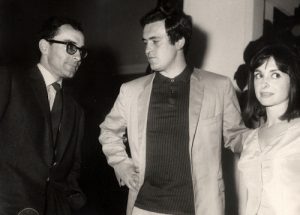
Jean-Luc Godard, Bernardo Bertolucci, and Adriana Asti, Cannes 1964
THE NOUVELLE VAGUE, GODARD AND THE CAHIERS
MUCH LOVE FOR CHAPLIN
Chaplin Today: Limelight (France/ 2002) by Edgardo Cozarinsky, featuring Bernardo Bertolucci © MK2TV / Roy Export Company Establishment / CNDP
The Smile of Renoir
by Bernardo Bertolucci
In 1974, during the casting for 1900, I was in Los Angeles searching for the actor who would interpret the role for which I later chose Robert De Niro. I took the opportunity to go and meet Jean Renoir, who at the time was in his eighties and lived in Bel Air. I was very excited, because Renoir had always been one of my heroes – I still consider him one of the greatest film directors of all times. I found him in his living room, surrounded by large green plants, sitting on a wheelchair with a blanket over his legs. There was a sculpture right beside him, a bust made by his father Auguste, depicting Jean at the age of five or six. I was struck by the fact that the sculpted smile of the child was exactly the same as the smile of the eighty year-old. We started talking about cinema, and he turned out to be the most lucid and open-minded person I had ever had a dialogue with. Towards the end of my visit he told me something I will never forget: ‘Il faut toujours laisser une porte ouverte sur le plateau; parce qu’on sais jamais, il y à toujours la chance que quelqu’un puisse entrer, et on l’attendait pas; et ça c’est le cinéma’, On the set you always have to leave a door open, because you never know, there’s always the chance that someone will come in unexpectedly; and this is what cinema is about. Whenever I shoot a movie, this is the first rule I follow. To leave a door open means, for example, that if the leading actress arrives in the morning with her face looking exhausted, perhaps because she didn’t sleep at all the previous night, rather than covering her with makeup, I try to put this to good use. Or if, during an exterior shot, a sudden cloud covers the sun, rather than giving up the shot entirely or resorting to other solutions, I joyfully welcome the apparent difficulty and use it to communicate to the viewer a different, powerful emotion. In other words, you always have to be ready to accept what real life presents you with. You always have to be ready to draw on the actors’ creative abilities and their unexpected insights, which is part and parcel of the role of the film director as someone bound to real life by a mysterious and indefinable connection.
[Transcribed by Aelfric Bianchi. Originally published in La Valle dell’Eden, no. 10-11, Paolo Bertetto and Franco Prono (eds.), Lindau, Torino 2002; republished in Bernardo Bertolucci, La mia magnifica ossessione. Scritti, ricordi, interventi (1962-2010), Fabio Francione and Piero Spila (eds.), Garzanti 2010]
Robert Bresson: Tracks in the Sand
by Bernardo Bertolucci
Over the last years, Bresson’s name has become a word, an entity, a sort of synonym for poetic rigor in cinema. My friends and I understand ‘Bressonian’ to indicate an extreme, moral, unattainable, sublime, punitive cinematic tension. It is punitive because his films are powerful, sensual experiences with no respite (except for the aesthetic respite, which is in itself a devastating pleasure).
One day I was told that Bresson was in Rome for a lecture at the Centro Sperimentale di Cinematografia. I ran, and arrived in the middle of it. Standing behind a wall of students, I could only see his head’s white, immaculate crown slowly moving. He never used the word cinéma, but always le cinématographe. All the rest was théâtre filmé. When I caught a glimpse of his face, perhaps only for three seconds, he reminded me of a hypnotic rabbit. My legs were shaking with admiration. Was it 1964 or 1965? That afternoon, Mauro Bolognini invited me to a dinner in honor of Bresson, who had been in Rome a couple of weeks preparing an episode of The Bible, a series of films by different directors produced by Dino De Laurentiis. Bresson had chosen Noah’s Arc. Before introducing me, Bolognini told me that Bresson was in a particularly bad mood, and told me why. In the morning, while Bresson was giving his lecture, Dino De Laurentiis had gone to the sound stage and seen large cages with pairs of wild animals: a lion and a lioness, two giraffes, one male and one female, two hippopotamuses, one male and one female, and so on. A few hours later, Dino told Bresson how excited he was by the idea of being the only producer in the world who could bring the brilliant Maestro down to earth, producing a movie with real production value and commercial potential. ‘On ne verra que leur traces sur la sable’, Bresson whispered to Dino, ‘We will only see their tracks in the sand’. An hour later he was fired.
So there I was, sitting across from Bresson. It was early summer, on a terrace in Via di San Teodoro. Behind him I could see the Palatine Hill, white ruins in the darkness. I must have mumbled something to the effect of: ‘Before placing a bomb in De Laurentiis sound stage… may I ask if… maybe there is someone… in the history of le cinématographe… whom you like more… is there a film you prefer… or more than one?’.
He shifted his gaze away from me. ‘No.’ Then, with an extraordinary spirit of precision, he corrected himself: ‘Perhaps a few shots by Chaplin. When he’s not in them’. I told him I adored Les dames du Bois de Boulogne. He still hadn’t made Au hazard Balthazar (Balthazar), Mouchette, Une femme douce (A Gentle Woman), Quatre nuits d’un rêveur (Four Nights of a Dreamer), Lancelot du lac (Lancelot of the Lake), Le diable probablement (The Devil Probably), L’argent (Money). As I write this text, Bresson has suddenly become once again the name of a person. A Frenchman. Or a Taoist.
[In Bianco e Nero, January-February 1990, Scuola Nazionale di Cinema-CSC, Roma 1999; originally in Robert Bresson, James Quandt (ed.), Cinémathèque Ontario, Toronto 1998; republished in Bernardo Bertolucci, La mia magnifica ossessione. Scritti, ricordi, interventi (1962-2010), Fabio Francione and Piero Spila (eds.), Garzanti 2010]
L'atalante by Jean Vigo
Bernardo Bertolucci about L’Atalante by Jean Vigo.
With Orson Welles in L.A.
A Letter to Giulietta Masina
by Bernardo Bertolucci
Dear Giulietta
We’ve never met, I only know you as an immensely talented actor. Perhaps you know of me because of a few of my films.
Dear Giulietta,
I met Federico for the first time at an almost clandestine, and for me historic and unforgettable, screening of the rough cut of La dolce vita, in Cinecittà. Anticipating the atmosphere of heavy censorship that was descending on the movie like a bank of fog, Federico had invited Pier Paolo, my father, and a few other intellectuals to the screening to try and rally their solidarity and get their opinions. I ‘gate-crashed’ the event, without knowing or even imagining what I would have seen.
Of all the experiences that led me to my choice of career, it was the deepest and most astonishing.
The film still hadn’t been dubbed, and the sound was an extraordinary concoction of voices in different languages. The voices chased each other and intertwined, probably without understanding each other, creating a fascinating music of harmony and dissonance, on top of which one constantly heard Federico’s voice-over, as he guided, stimulated, inspired, and made fun of (ugly little thing, stupid, senile!) the actors – an invisible character but a very powerful presence.
I was just 17 years old, and the emotional impact of that screening was a turning point in my life.
Along with the few others present that night, I had the privilege of witnessing the creation of a universe. Via Veneto, the paparazzi, the starlets, the aristocrats – nothing of this existed in reality. It was the miracle of cinema inventing what is not there.
It is true that life imitates art, and La dolce vita proves it. In the following years, the Via Veneto and the dancing nights depicted in the film materialized in real life and were identical to those seen in the movie.
I was just 17 years old, and the emotional impact of than night was one of my life’s defining moments.
I never had the opportunity to confess this to Federico (whom lately I met at Antonio’s barbershop and for brief moments in via Margutta, where in April and May I edited part of my movie) and I feel I must at least tell you.
I would also like to express to you, briefly, something I experienced while I was in Rome during the seven or eight days before Federico abandoned us.
Italy was (and still is) the stage for incredible fireworks, scandals, scoops, revelations. It was a constant parade: the Mata Haris, the coup-attempting generals, the Poggiolinis with gold ingots, the Moro affair back on the front pages, etc.
Then suddenly everything fell back into its right place, because the only moving, harrowing thing, the only thing that really mattered, was the presence of Federico on his hospital bed.
Those days were for me (and I believe for many others) days of deep reflection and incomparable enrichment. I believe that…
[the letter stops here, probably never sent, then found on one of Bertolucci’s notebooks]
Edgar Reitz's Heimat
A correspondence between Bernardo Bertolucci and Edgar Reitz about Heimat and 1900.
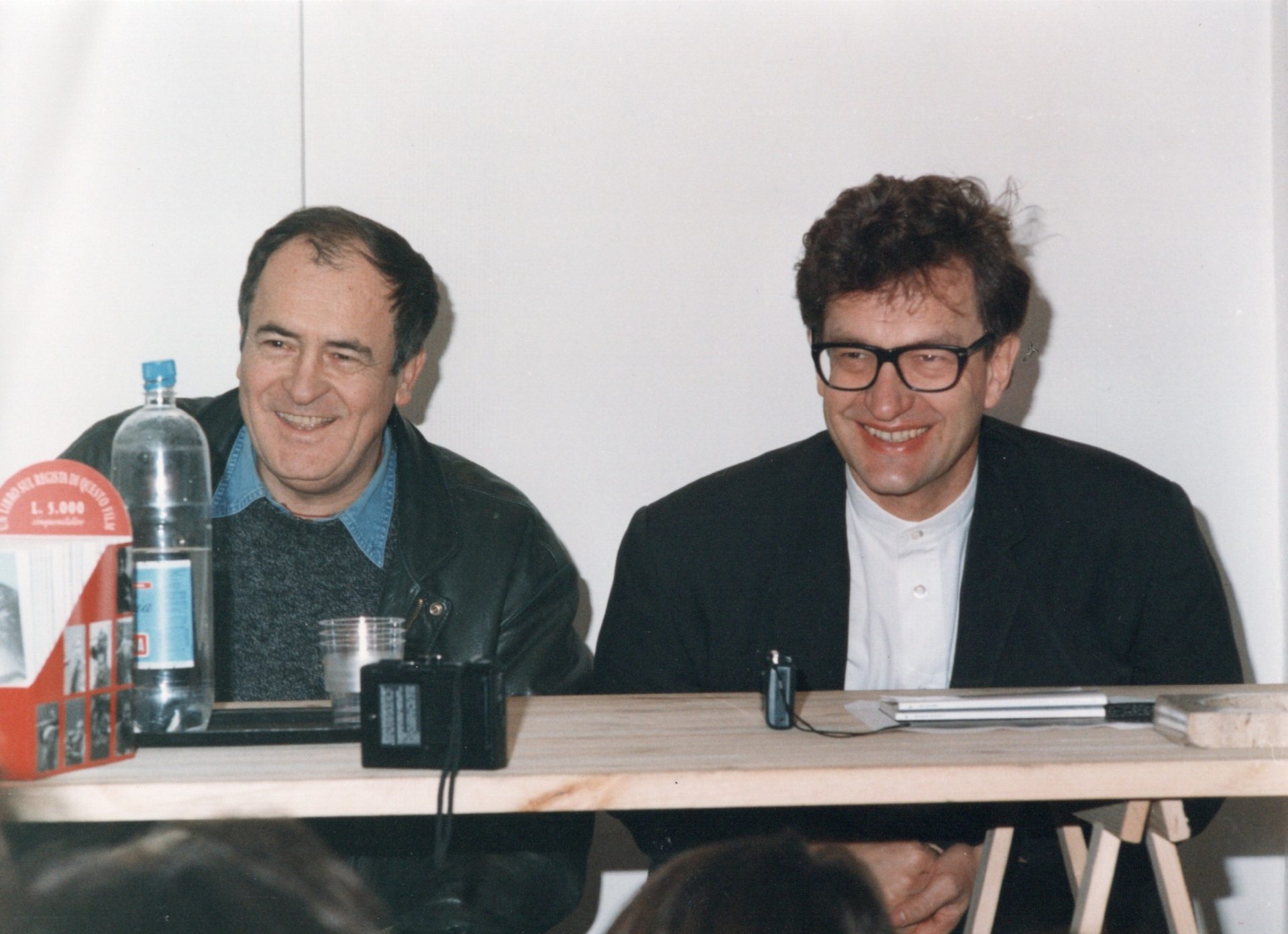
My Friend Wim Wenders: Memories
Bernardo Bertolucci's Guilty Pleasures
I’m not guilty about what I like, which is more or less the whole history of cinema, so it’s difficult to list many. I was glad to see that Quentin Tarantino wrote a movie, From Dusk Till Down, that is all based on Guilty Pleasure — it’s Guilty Pleasures on the screen. To me it’s a quotation of Mario Bava, the Italian vampire film, and the Hercules movies of the Fifties and Sixties, which Quentin seems to like, all together. I’m not really a big fan of the Hercules films — maybe some of Vittorio Cottafavi’s. I remember that I did like Ercole alla conquista di Atlantide (Hercules and the Conquest of Atlantis, ’61).
Cat People (Val Lewton and Jacques Tourneur, ’42): it’s never considered a classic. For me it’s a classic. I think it’s very parallel to Les Dames du Bois de Boulogne. I see the movies as quite close to each other. They were made around the same time and they have a similar atmosphere. Casarès in Les Dames is a cat woman. When she sees her ex-boyfriend leaving and says, “Je me vengerai” — “I will have my revenge” — there is something in her which is very much like Simone Simon when we understand that she is tormented because she cannot avoid doing what she will do. It’s following nature and being condemned to that. I find the two movies mirror one another. And Tourneur was originally French. I wanted to have Jean Marais quote a line from Cocteau’s script for Les Dames du Bois de Boulogne in Stealing Beauty — another guilty, secret pleasure: “Il n’y a pas d’amour, il n’y a que des preuves d’amour” — “Love doesn’t exist, only proof of love”.
And I must say that we shouldn’t forget Paul Schrader’s Cat People (’82), which I quite like. I thought it was very brave to remake such a masterpiece. And in some way Kinski is also haunted by something — always, in her life. She was a very good choice.
Typhoon Club (Shinji Sōmai, ’84): I was on a jury at the Tokyo international film festival and we gave the Best Picture Award to this Japanese film, which is a story of adolescence that takes place away from Tokyo. A few kids remain trapped in their school when a typhoon comes, and the school is in the eye of the typhoon. It’s one of the most beautiful and touching films about adolescence, absolutely devastating, with the violence as if these kids still had the kind of mental confusion between guilt and heroic ideals that young Germans used to have in the Sixties. Fantastic film in CinemaScope.
Speed (Jan de Bont, ’94): I like it because it’s really one of the few occasions where there is such a total lack of psychology that pure action takes over. It’s very hard to achieve this; they’ve tried many times to do comic strips and it doesn’t work. But in Speed it becomes abstract, like a machine. I like it for its lack of human motivation apart from The Goody and the Baddy. It’s very pure.
Gun Crazy (aka Deadly Is the Female, Joseph H. Lewis, ’49): It’s as good as À bout de souffle (Breathless). The love story between Peggy Cummins and John Dall is based on their talent — they admire each other’s talent. Talent in what? In shooting. They meet at a shooting competition and are equally good shots. Then shooting becomes wicked and they start to rob banks. We discover that she’s quite capable of walking over his dead body, like the girls in The Maltese Falcon and Build My Gallows High (i.e., Out of the Past). Generally in these kinds of B movies the women are more interesting than the men; in normal established Hollywood cinema, women always had to be conventional in those days, while in the B movies they had the freedom to have these fantastic negative female characters. The reason I mentioned À bout de souffle, in fact, is because at the end Jean Seberg betrays Belmondo and he says “dégueulasse” — she’s like the girls Belmondo has imagined. They can be wicked – and yet: they are innocent because we see them through the eyes of men who love them, and the directors love them. Maybe we love them because they are wicked.
Snow White (Walt Disney, ’37) was the first film I ever saw. I must have been 5 and I was terrified. I have remembered for years when Snow White runs through the forest and the branches become like skeleton arms. When I saw a child I’d go to the movies on Sunday in Parma in the South. I loved American war movies and didn’t miss any from about 1949 to 1953. They Were Expendable (John Ford, ’45) was a favorite. And Westerns. Of course I was in love with John Wayne and thought I looked like him and walked like him. My father owned a little land and I had friends who were too poor to go to the movies, so I had to tell them everything that happened, and then we would all act them out. I was directing a little bit, playing John Wayne, and I always loved to die, playing these incredible, elaborate American movie deaths in the Po Valley countryside.
Le Plaisir (Max Ophüls, ’51): one of my favorite films, not a Guilty Pleasure but there’s a nice story. My wife took me to see it nine years ago in Paris, and the first episode, “The Masque”, I was so excited that I got a fever and couldn’t stay for the other two episodes. Two or three years later, in a little cinema in Rome called Film Studio, Le Plaisir was showing, so I went again and saw the first part, and then the second, “Le Maison Tellier”, in which the brothel closes so that all the hookers can go to the Holy Communion of the daughter of one of them. And it was so beautiful I couldn’t stand it — it was too moving. And again, I felt had a fever and I left the theater. A few years later I could see the third episode, “La Modèle”, which is devastating. Daniel Gélin is a painter who gets involved with his model, but she’s a neurotic person who drives him crazy and jumps from the window and breaks her legs. There is the line, “Le plaisir n’est pas gai”.
Crash (David Cronenberg, ’96): it’s the first one of a long series, I hope, of contes morales pour nous. It is a completely pornographic film because there’s no story and the characters are defined not by their psychologies but by their sexualities. But it is done in a kind of really extraordinarily serious way — grave, solenne.
La signora senza camelie (Michelangelo Antonioni, ’53): a beautiful Antonioni film that is very underrated — it’s one of his best. It’s all Antonioni but before he became consciously existentialist. There was more story than later with L’avventura which was about sottrazione — a young woman disappearing. L’avventura was the beginning of something modern in cinema. It comes from Rossellini’s Viaggio in Italia very much, that way of seeing the South of Italy in a non-folkloristic way, and George Sanders and Ingrid Bergman were very much like Antonioni characters. I saw La signora senza camelie at Antonioni’s house twelve years ago. There is a moment in the film where the director and his girlfriend, the actress, go to the Venice festival with their film, and the film is so booed that they leave halfway through — which would happen to Michelangelo with L’avventura in Cannes, where they were so cruel that Michelangelo and Monica Vitti ran away crying. In the film they leave while hiding their faces, and they meet a critic who’s a friend of theirs and he says, “The second time it’s even worse”. A kind of nightmare! It’s so much about failing in cinema and love — the girlfriend can’t act, but the director thinks his love can make her act.
I thing it’s disgusting what’s going on in the last ten years. I remember in the Sixties and Seventies, when a movie was successful, everybody regarded it with suspicion. Success meant “commercial”, “compromise”. I found that stupid. I loved American cinema when in Italy, I swear, almost everybody who was politically committed was ferocious towards American cinema. Later I wrote a piece on Cimino’s The Deer Hunter, a communist cultural magazine asked me to do it because they liked it but they didn’t dare say. Today, the opposite happens. If a movie is not a commercial success, it dies and is despised even by people in quite sophisticated positions. It’s like a Pavlovian response.
[Film Comment, July-August 1996]